How to Choose the Best 5 Axis Machining Center for Your Business Needs?
Selecting the right 5 Axis Machining Center is crucial for business success. According to industry expert John Smith, "Choosing the right machine can make or break production efficiency." The demand for precision and versatility in manufacturing drives the need for advanced machining technology.
A 5 Axis Machining Center provides significant advantages in complex part production. Its ability to cut complicated geometries saves time and resources. However, not all options suit every business's unique needs. It's essential to assess your specific applications, production volume, and budget constraints.
Consider the user-friendliness and support offered by the manufacturer. Training and maintenance services are vital. Reflection on past experiences can guide your decision-making process. Are you prioritizing capabilities over features? Achieving the right balance is pivotal for maximizing your investment and enhancing productivity.
Understanding the Basics of 5 Axis Machining Centers
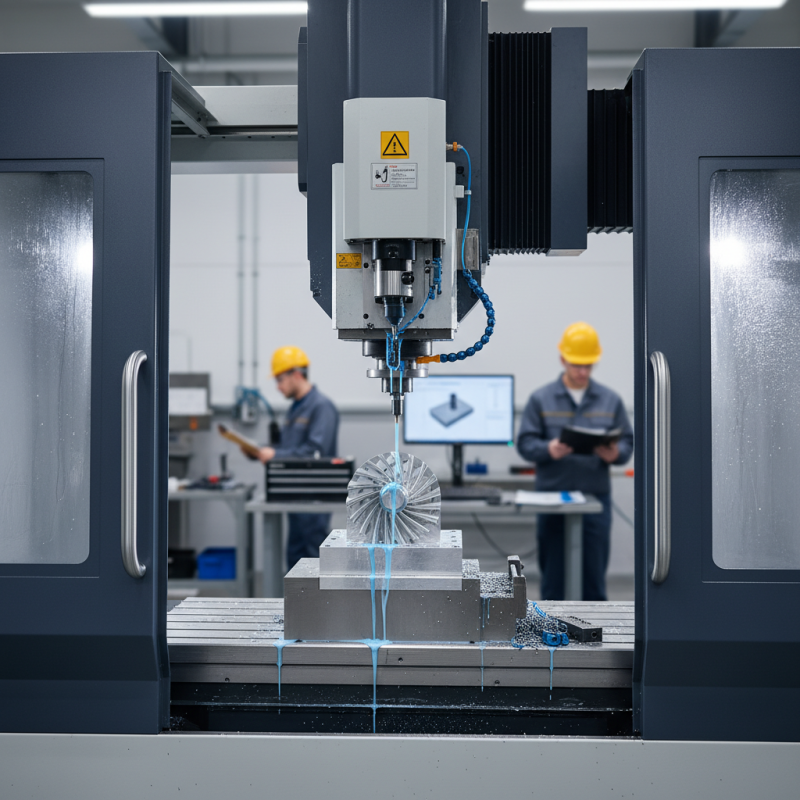
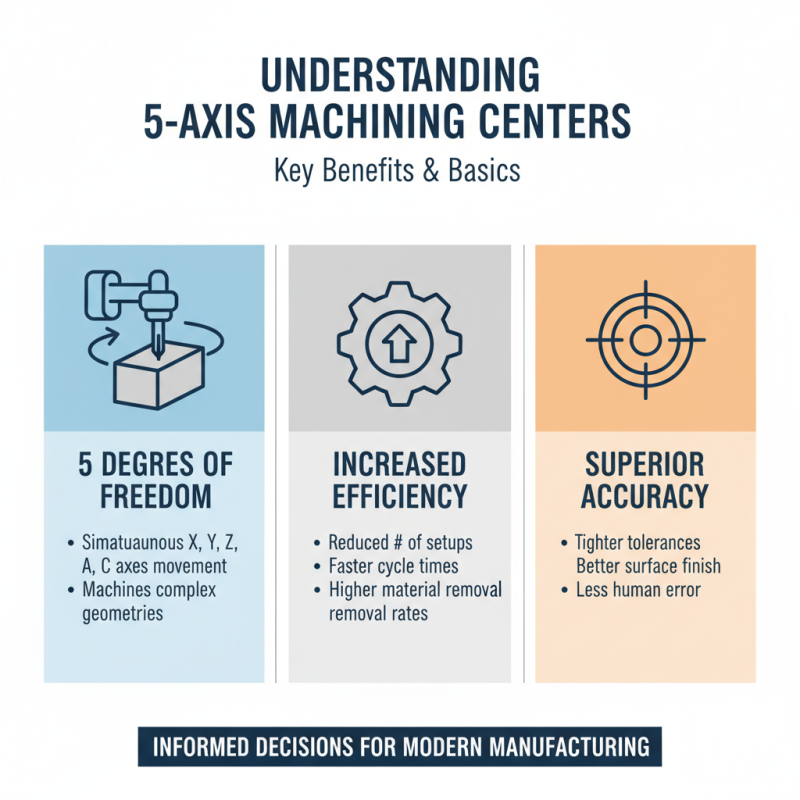
Choosing a 5-axis machining center can be challenging. Understanding its basics is crucial for making an informed decision. A 5-axis machining center has five degrees of freedom. This allows for complex geometries. With this technology, you can reduce the number of setups required. It increases efficiency and accuracy in production.
These machines excel in creating intricate parts. For industries like aerospace and automotive, precision is vital. Each axis can move independently. This means you can approach the workpiece at various angles. However, this complexity can also lead to operational challenges. Training is essential to maximize the machine’s potential. Neglecting this can result in costly mistakes.
When considering a 5-axis machine, think about your specific needs. Some may require higher speeds while others focus on precision. Reflect on the materials you commonly work with. Different machines handle materials uniquely. Evaluating these factors will help in selecting the right center for your operations.
Identifying Your Business Requirements for Machining
Identifying your business requirements is crucial when selecting a 5-axis machining center. Understanding your specific needs dictates your choice. For instance, consider the materials you often work with. Aluminum is common but requires different settings than titanium or composites. Each material has distinct machining characteristics and tolerances.
Performance metrics are vital considerations. Research shows that businesses prioritizing precision may benefit from centers with lower tolerances, often below 10 microns. Additionally, a survey reveals that 75% of manufacturers report improved efficiency when using machines capable of simultaneous 5-axis operations. This highlights the importance of productivity in your decision-making.
Don't overlook your production volume. Low-volume scenarios may not justify a high-end model. However, if your workload includes complex components, investing in a robust system is necessary. Flexibility is another aspect to ponder. Some machines may excel in adaptability but lack speed. Balancing these factors requires careful reflection on your operational goals.
Comparison of Key Features for 5 Axis Machining Centers
This chart illustrates the importance rating of key features to consider when selecting a 5 Axis Machining Center for your business needs. A higher rating indicates greater significance in decision-making.
Evaluating Key Features and Specifications of 5 Axis Machines
When selecting a 5-axis machining center, focus on the machine's key features and specifications. Important aspects include spindle speed, axis movement, and workpiece size capacity. A higher spindle speed often means faster production. Also, check how the axes move. Some machines have continuous rotary axes, while others don't. This can impact your ability to create complex parts.
Tips: Evaluate your projects. If you're mostly machining simple shapes, a less advanced machine might suffice. For intricate designs, opt for higher precision features. Do not overlook the machine's size. Ensure your workspace can accommodate the equipment.
Consider the controller too. A user-friendly interface simplifies operation. Software compatibility is crucial as well. You want a machine that integrates well with your existing systems. Remember, the maintenance cost can escalate with more advanced machines. It’s a factor to weigh carefully.
Finally, think about the future. What will your business need in two or three years? Machines can be a significant investment. Aim for flexibility in capabilities to adapt to changing demands.
Comparing Different Brands and Models in the Market
Choosing the right 5-axis machining center involves careful evaluation. Various brands and models offer distinct features and capabilities. Some machines excel in speed, while others focus on precision. It's vital to match the center's strengths to your specific business needs.
A thorough comparison reveals that some models may appear ideal but fall short in real-world applications. For example, a machine advertised as user-friendly may have complex software that requires extensive training. In terms of maintenance, some units may demand frequent servicing, leading to downtime and lost productivity.
Pricing is another important factor. Higher costs don’t always guarantee superior quality or performance. Potential buyers should consider long-term costs, including tooling and spare parts. It’s essential to gather insights from current users. This feedback can uncover hidden advantages and pitfalls. Each machine has its pros and cons; understanding these nuances is crucial to making an informed decision.
Budgeting and Financing Options for Your Investment
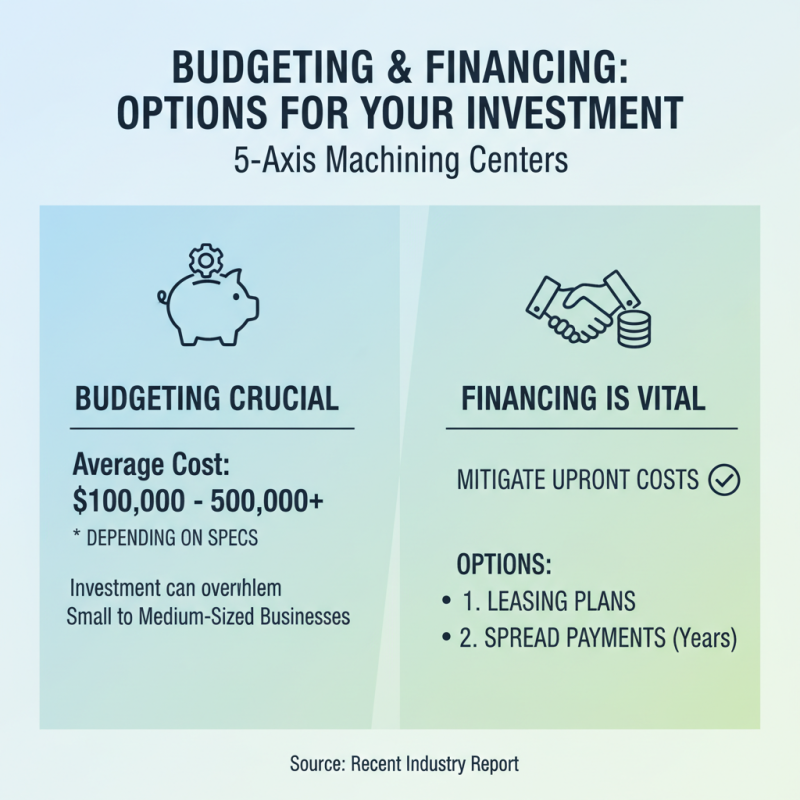
When considering a 5-axis machining center, budgeting is crucial. According to a recent industry report, the average cost of these machines ranges from $100,000 to over $500,000, depending on specifications. This investment can overwhelm many businesses, especially small to medium enterprises. Financing options are vital for mitigating upfront costs. Many manufacturers offer leasing plans, allowing companies to spread payments over several years.
For businesses aiming to leverage advanced machining technologies, understanding the total cost of ownership is essential. This includes maintenance, tooling, and software expenses. Overlooked factors can lead to financial strain. Reports indicate that up to 20% of total cost can derive from these additional factors. Additionally, explore government grants or industry-specific financing programs. These can provide financial relief and incentivize technology adoption.
Equipment financing rates can vary significantly across providers. Interest rates could be as low as 0% for qualified buyers, while others may face rates above 10%. This disparity emphasizes the need for detailed research. A strategic approach to budgeting not only enhances planning but also better prepares a business for potential challenges in the future. Balancing price and features is a task worthy of reflection and careful consideration.